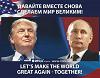
Enligt Foreign Policy är Finland tämligen dålig grogrund för putleristernas trollande, i jämförelse med många andra länder vare den höga utbildningsnivån, den långa historien av umgänge med makthavarna i Moskva - oavsett vad de heter - samt att man på högsta ort länge varit medveten om fenomenet och förstått att bemöta det.
I kommentarsfältet till Helsingin Sanomat-artikeln lovordas även de finländska medierna.
Why Is Finland Able to Fend Off Putin’s Information War?
https://foreignpolicy.com/2017/03/01/why-is-finland-able-to-fend-off-putins-information-war/
http://www.hs.fi/ulkomaat/art-2000005111542.html
Citat:
But in the face of this mounting pressure, one of Russia’s neighbors has emerged unusually resistant to the wider information war waged by Moscow across Europe: Finland.
Like other countries along the Baltic Sea or in Eastern Europe, Finland has seen a notable increase in fake news stories and propaganda targeted against it that can be linked back to Russia since Moscow’s annexation of Crimea in 2014. These attacks have sought to undermine the government and often coincided with military shows of force along the Russian border.
But unlike its neighbors, Helsinki reckons it has the tools to effectively resist any information attack from its eastern neighbor. Finnish officials believe their country’s strong public education system, long history of balancing Russia, and a comprehensive government strategy allow it to deflect coordinated propaganda and disinformation.
“The best way to respond is less by correcting the information, and more about having your own positive narrative and sticking to it,” Jed Willard, director of the Franklin Delano Roosevelt Center for Global Engagement at Harvard, told Foreign Policy. Willard, who is currently working for the Swedish government, was hired by Finnish officials to help them develop a public diplomacy program to understand and identify why false information goes viral and how to counter propaganda.
That initiative started at the top. In October 2015, Finnish President Sauli Niinisto took the first step, when he acknowledged that information warfare is real for Finland, and said that it was the duty of every citizen to combat it. In January 2016, the prime minister’s office enrolled 100 officials in a program across several levels of the Finnish government to identify and understand the spread of disinformation based on Willard’s advice.
A homogeneous country of 5.4 million people, Finland routinely ranks at the top of the Organisation for Economic Co-operation and Development’s quality of life metrics and, in addition to strong social welfare programs, the country’s education system is the best in the world, according to the World Economic Forum.
Willard says this combination of widespread critical thinking skills among the Finnish population and a coherent government response makes a strong defense against concerted outside efforts to skew reality and undermine faith in institutions.
“This stuff is real. It is as real as war,” said Willard. “But the Finns very quickly realized this and got out in front of the problem.”
René Nyberg, a former Finnish ambassador to Moscow, says Finland has a couple of key advantages when it comes to parrying Russian disinformation. Helsinki is painfully well-versed in dealing with Russia, as it has had to do through war and annexation, and most recently the decades-long staring match of the Cold War. That left Finland with a sober understanding of the Kremlin’s real motives. Plus, it helps that Finland is not Russia’s main target when it comes to undermining European unity.
“The real intensity is Germany … Merkel is the main course,” Nyberg told FP. “We’re just a side dish.”
Förutom att Finland är dålig jord för Kremls giftsådd, så noterar FP att landet erbjuder få ämnen som putleristerna anser värda att exploatera. Den bedrövlige
Johan Bäckman och hans insatser vid de
famösa finsk-ryska barnskyddsgrälen kommer dock med på ett hörn.
Citat:
--- Finland, which ranks as the world’s third-least corrupt country according to Transparency International, and which has only a tiny Russian-speaking population, has fewer obvious targets to be exploited. In March 2016, the Finnish-language bureau for Sputnik, the state-funded Russian media outlet, closed after it failed to attract enough readers.
---
Finnish officials claim to have documented 20 disinformation campaigns against their country that have come directly from the Kremlin. Those attempts tend to focus on a narrow but sensitive topic: Helsinki’s carefully balanced relations with Moscow.
----
Russian disinformation campaigns have spun a narrative of the Finnish government discriminating against ethnic Russians. In February, reports of dual Russian-Finnish citizens being rejected from military and foreign service jobs became a talking point in pro-Kremlin media in Russia. A measure discussed in Finnish parliament to prevent Russian citizens from owning land near military sites also rallied the pro-Kremlin propaganda machine. A similar line of attack, which has involved doctored photos, saw Kremlin outlets accuse Finnish authorities of child abduction in disputes arising over child welfare and custody battles for Finnish-Russian marriages. The accusations, which Finnish officials deny, first materialized in 2012, but continue to flare up — giving Russian lawmakers more opportunity to make inflammatory statements about their neighbor.
“It’s not just about Finland’s relationship with Russia,” Saara Jantunen, the author of Info-War, a book about Russian disinformation in Finland, told FP. “It’s about showing what kind of rhetoric in Finnish society and the media is acceptable.”
----
One noticeable aspect of the Kremlin’s approach in other parts of Europe is to support anti-establishment forces, which often parrot pro-Russian positions. A similar dynamic is at play in the case of Jessikka Aro, an investigative journalist for the social media division of Finland’s state broadcaster, Yle Kioski.
In 2014, Aro followed up on reports of a Russian “troll factory” in St. Petersburg that was seeking to influence public opinion in the West about Kremlin maneuvers abroad. After she published her initial investigation, which documented how pro-Russian voices were attempted to shape the public discourse on Ukraine, her name appeared on Russian nationalist websites where she was derided as a Western intelligence agent, bombarded with anonymous abusive messages on social media, and labeled a drug dealer.
The man who became the main voice targeting Aro was Johan Backman. An outspoken supporter of the Kremlin who is fluent in Russian, Backman — a Finn — was responsible for the bulk of the derisive commentary that appeared about Aro. Backman serves as the representative in Northern Europe for the Russian Institute for Strategic Studies, a state-funded research group known for its Kremlin connections during the Cold War and currently led by a Soviet-era intelligence officer. Backman has defended his commentary as free speech.